Find Your Center
Get the latest on hidden gems, events, and trip ideas in the heart of Oregon.


Feeling Small in a Big Cosmos
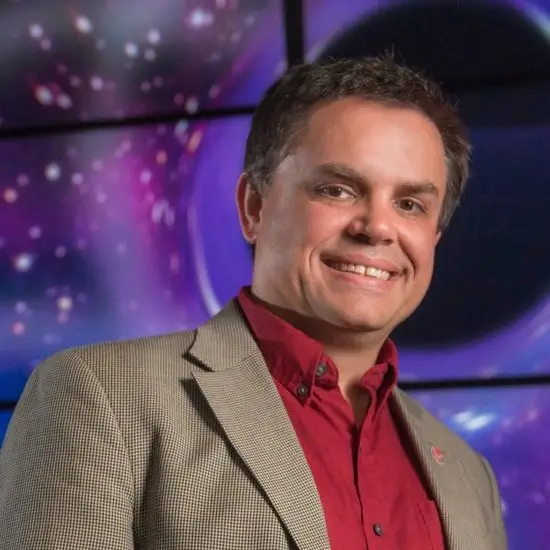
Shane L. Larson
Clarkson University
Standing in a dark country meadow, staring up at a sky full of stars and the diaphanous glow of the Milky Way, it is easy to feel small. Staring at pictures from the Hubble Space Telescope, it is easy to be stunned by the effortless beauty of the Cosmos. Faced with the knowledge that our planet is only one small speck among a hundred billion galaxies and a billion-trillion stars, it is easy to feel insignificant.
But we live at a unique moment in human history. We are the first humans to ever see a picture of the Earth, hanging against the darkness of the night. We are the first humans to ever know what lies on the surface of Mars, or behind the thick fog of Titan’s clouds. We are the first humans to ever know that we are deeply connected to the stars themselves. It is easy to forget how hard it was to win that knowledge, and how awesome it is that we can understand — that is the hallmark of our relationship with the Cosmos.
In this chat, we’ll examine some of the story of how newfound knowledge has continually forced us to abandon cherished ideas about the Universe, leading us from a time when we believed Earth and humanity were the center of all things, to today, where we are one small part of the greater Cosmos.
————————–
BIO
————————–
Shane Larson is a professor of Physics at Clarkson University and the co-Director of PEAK, Clarkson’s Experiential Learning Hub. He works in the field of gravitational wave astrophysics, specializing in studies of compact stars, binaries, and the galaxy with both the ground-based LIGO project, and the forthcoming space-based observatory LISA. He is an award winning teacher, and a Fellow of the American Physical Society. He is an avid amateur astronomer, observing with two homebuilt Dobsonians, a 12.5″ named EQUINOX and a 22″ named COSMOS MARINER. He contributes regularly to a public science blog at writescience.wordpress.com, and posts at Bluesky with the handle @sciencejedi .
All registration income beyond the cost of event raises funds for Cascade Astronomy & Rocketry Academy, a non-profit educational organization.
Find Your Center
Get the latest on hidden gems, events, and trip ideas in the heart of Oregon.