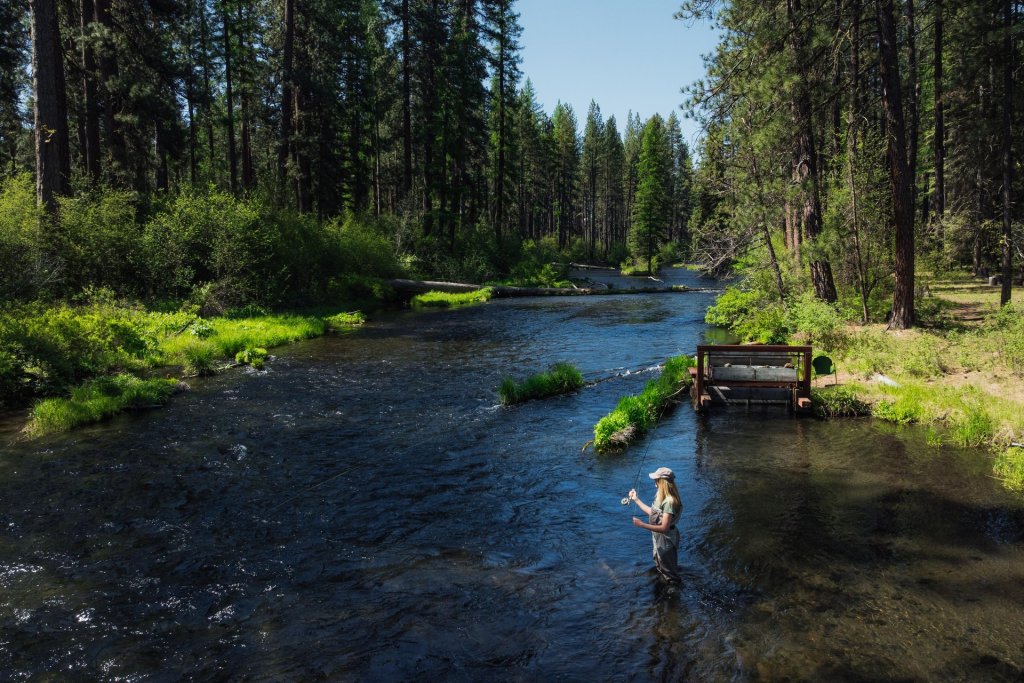
It’s no accident that the fabled Oncorhynchus mykiss, aka steelhead, is dubbed the “fish of a thousand casts”—it’s not uncommon for novice steelhead anglers to fish for years without ever hooking into, let alone landing, one of these powerful and acrobatic sea-run rainbow trout. There’s also a reason why they keep trying. For many, the first steelhead is one of the most memorable fishing experiences that you’re likely to find anywhere.
Thankfully in Central Oregon, we have the good fortune of possessing some of the world’s most prolific steelhead rivers, foremost among those is the Deschutes. Not the slack water that flows through the center of Bend, but the muscular “lower” Deschutes that emerges from Lake Billy Chinook, carving its way through a broad shouldered basalt canyon to the river’s confluence with the Columbia River, about ten miles east of The Dalles.
It’s here in August that the summer steelhead season kicks off with anglers chasing early arriving steelhead fresh from the ocean en route to their spawning grounds. By October and early November Deschutes-bound fish have made their way closer to Central Oregon with many fish collecting in the area around Warm Springs.
For Central Oregon residents and visitors alike, now is the prime time to target these coveted game fish on half, single, and multi-day trips offered by many of the local guide services, all of whom offer full-service experiences, including instruction, gear and shore-side lunches.


Photo by Bryan Darby
The most popular section of river and the most accessible is the roughly six-mile stretch of water between Warm Springs and Trout Creek.
“While steelhead fishing is rarely red hot longer than a few days or a few hours, overall run numbers have been average to good this year”, said Scott Cook, owner of Fly and Field Outfitters in Bend, one of the shops that specializes in guiding steelhead anglers on this section of river. “We are seeing bigger wild fish caught this year,” said Cook, who observes that some anglers have not necessarily tempered their expectations from the record runs experienced four and five years ago, when multi-fish days seemed the norm.
It’s about being on the river at the right time in the right place if you want to hook into one of these fish that can range from four pounds up to 12 and 13 pounds on the Deschutes. There are plenty of proven tactics for targeting Deschutes steelhead including traditional wet fly swing presentations that have been used on steelhead in the Northwest and Atlantic Salmon in the Northeast and Europe for close to 100 years, indicator nymphing and spinning gear. However, the technique that has caught on the fastest in recent years is the use of two-handed fly rods, or spey rods, that were developed in Scotland more than half a century ago and have been refined and modified for North American fishing conditions over the past decade.
These powerful rods are incredibly versatile but difficult to master. A great way to get introduced to this style is to book a trip with a guide service such as Deep Canyon Outfitters, Fly Fisher’s Place, Fly and Field or River Borne Outfitters that specializes in spey casting. This will allow you to incorporate a lesson into your day on the water. Of course, you can always go back to nymphing, but it might just change the way you think about fishing for steelhead, or anything else for that matter.
If you’re determined to go the DIY route, that’s fine, too. There is plenty of water and lots of public access near the town of Maupin. As fish migrate further upstream later in the year, the east side of the river near Warm Springs also offers public access. The west side is owned and managed by the Warm Springs Tribe and closes to public fishing Oct. 31, but is available after that through tribal guiding services.
All of the local shops are knowledgeable on flies and tactics and most are willing to give up a few not-so secret spots, if you promise to leave a few fish in the river. While no one can guarantee you a hook-up with the fish of a lifetime, the chances are as good now as ever. And as they fly guides say, even when customers aren’t around, “There are no bad days on the river.”